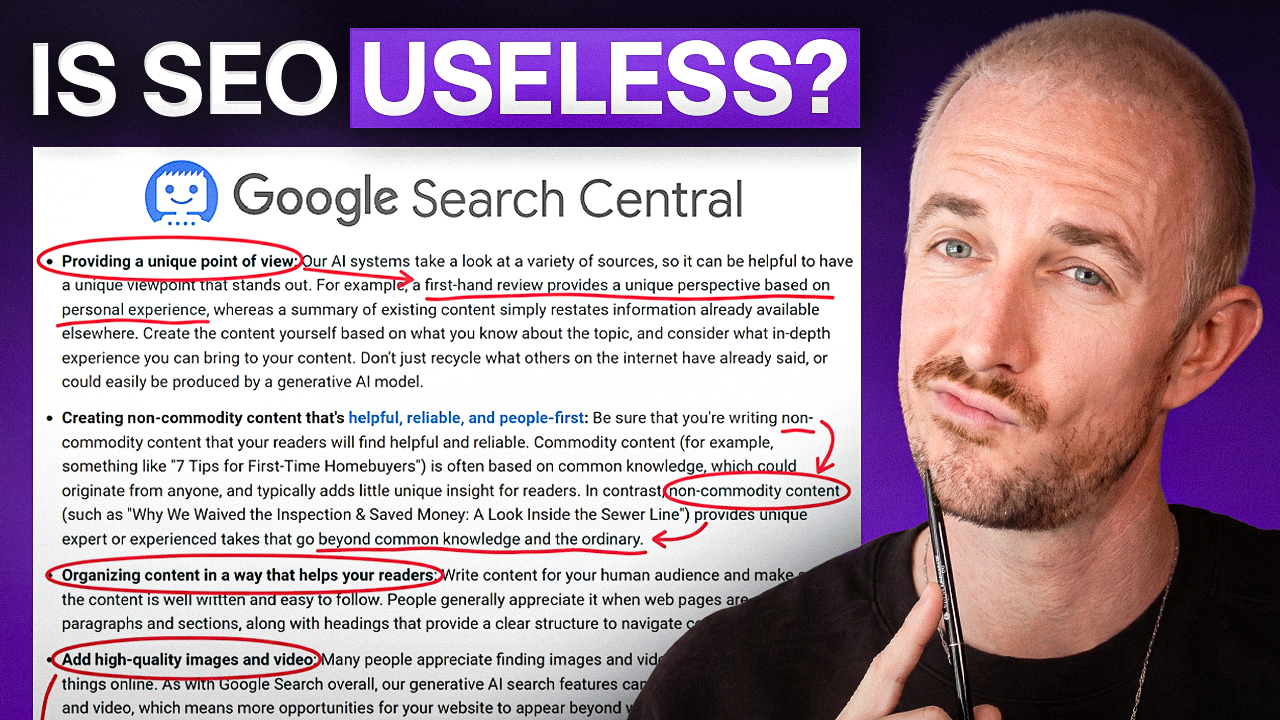
Nicely, Google’s AEO pointers have lastly dropped, and so they’ve mentioned it plainly. The identical search engine optimization finest practices nonetheless apply for Google’s generative AI expertise. That issues as a result of a whole lot of recommendation round AEO, GEO (Generative Engine Optimization), and AI search methods has been offered as if the Search Generative Expertise abruptly modified each rule in a single day.
I’ve labored in search engine optimization for greater than a decade. I’ve seen what occurs when search habits shifts quicker than the trade speaking factors. More often than not, the basics don’t disappear. They simply get repackaged.
That’s why the new Google Search Central guidance is price taking note of. It cuts by way of the noise and reveals what truly protects your natural visitors.
At its core, the message is easy: the format of search is altering. However the pages that win nonetheless earn visibility the old school manner. Within the period of AI-led search, the foundations of SEO matter greater than ever. Watch my full breakdown with commentary and sensible recommendation on methods to implement Google’s AEO pointers:
Key Takeaways of Google’s AEO Tips (search engine optimization for Generative AI)
- Google’s generative AI options nonetheless depend on the identical core rating and high quality methods behind common search.
- AI Overviews pull from reside pages within the Google index, so your website should keep crawlable, indexable, and authoritative.
- Search journeys now department into a number of associated queries, which makes topical authority and depth more practical than skinny pages.
- Generic, simple to repeat content material is dropping floor. Pages with first-hand proof, actual examples, and authentic media have a greater shot at being cited.
- You don’t want AEO tips or scaled long-tail pages. The pages that win nonetheless come from actual expertise, clear construction, and a technically sound website.
Search might look completely different on the floor, however the work that earns belief nonetheless comes from the web page itself.
How Google’s Generative AI Search Actually Works
In Google’s generative AI search guide, one thought retains developing: its AI options are constructed on prime of present search methods. That sentence does a whole lot of work as a result of it reframes how individuals take into consideration AI visibility.
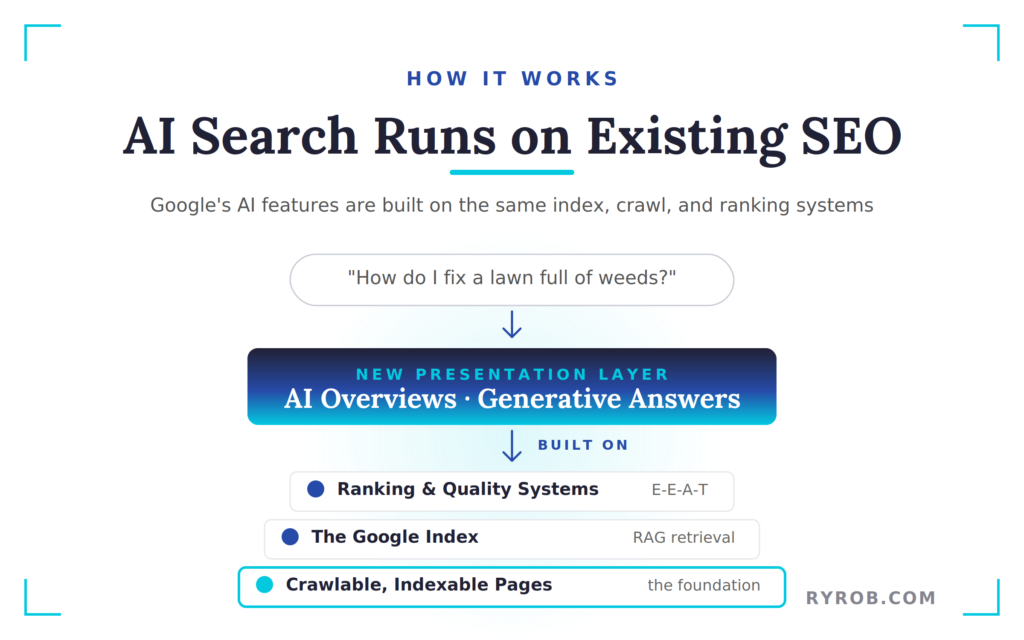
AI search is just not a separate system the place outdated rating indicators disappear. Google continues to be pulling from the online it has already crawled, listed, and evaluated, simply presenting the solutions in a special format.
That additionally explains why a lot new recommendation round AI visibility feels recycled. The labels modified, however the supply continues to be the identical internet pages, rating methods, and high quality requirements.
Retrieval-Augmented Technology (RAG) Nonetheless Pulls From Google’s Index
Lots of people discuss AI solutions as if the mannequin makes them up from reminiscence. That’s solely a part of the image. Inside the broader Search Generative Expertise ecosystem, Google depends closely on Retrieval-Augmented Generation or RAG.
The essential thought is easy. When Google wants a present reply, it may pull reside pages from its index and use these pages to help the response offered by Giant Language Fashions.
In case your web page is just not listed, or if it isn’t sturdy sufficient to floor, it has a a lot smaller likelihood of turning into a part of that reply.
That’s the reason old-school search fundamentals nonetheless matter a lot. If a web page can’t seem in regular search, it is not going to magically skip the road and present up in AI Overviews. The web page should exist in Google’s view of the online, and it should earn belief.
For publishers, the takeaway is sensible. Construct pages which can be price retrieving. A skinny web page with imprecise claims offers Google little or no to work with. A web page with clear construction, actual examples, and proof offers Google far more.
Question Enlargement and Content material Clustering
Google additionally explains question growth, and this issues greater than it could appear at first. One consumer query can set off a number of associated searches behind the scenes.
A search like “how do I repair a garden stuffed with weeds” would possibly department into questions on herbicides, prevention, timing, soil well being, and garden restore. Google makes use of question growth to collect pages throughout that wider cluster and construct a solution from a number of angles.
That is the place efficient content material clustering comes into play. By organizing your website round topical hubs, you show deep experience that helps set up your model authority. That doesn’t imply it is best to create a separate article for each tiny variation.
Actually, Google warns towards doing that when the aim is to control rankings or AI responses. That’s the place individuals get in bother with scaled content material abuse.
The good transfer is to cowl the subject with sufficient depth that your web page can fulfill a couple of associated want. When you need assistance mapping these associated searches with out turning your website right into a pile of skinny pages, this free keyword research workflow is a significantly better path.
The higher strategy is depth. A robust web page can reply the principle query and help associated ones naturally, with out feeling pressured.
Why the AEO Versus search engine optimization Debate Is Largely Settled
Google’s place right here is direct: optimizing for generative AI search continues to be optimizing for search. That makes the AEO versus search engine optimization debate a lot simpler.
AEO can nonetheless be a helpful label when speaking about visibility inside AI solutions. However in observe, Google treats it as a part of search engine optimization, not a alternative for it.
That is the place a whole lot of the confusion comes from. Some have positioned AEO as a very new self-discipline, when Google’s steerage factors again to the identical core ideas.
That doesn’t imply nothing modified. The shift is in content material high quality, usefulness, and the way clearly your web page helps help a solution.
The format advanced, however the basis stayed the identical.
What Google Means by Non-Commodity Content material
That is the middle of the entire information.
Google attracts a transparent line between commodity content material and non-commodity content material. Commodity content material is interchangeable, generic, and straightforward for anybody to provide.
You see it in every single place:
- “7 ideas for first-time homebuyers”
- “10 methods to lose stomach fats”
- “finest productiveness hacks for entrepreneurs”
None of those matters are dangerous, however 1000’s of pages repeat the identical concepts in nearly the identical manner.
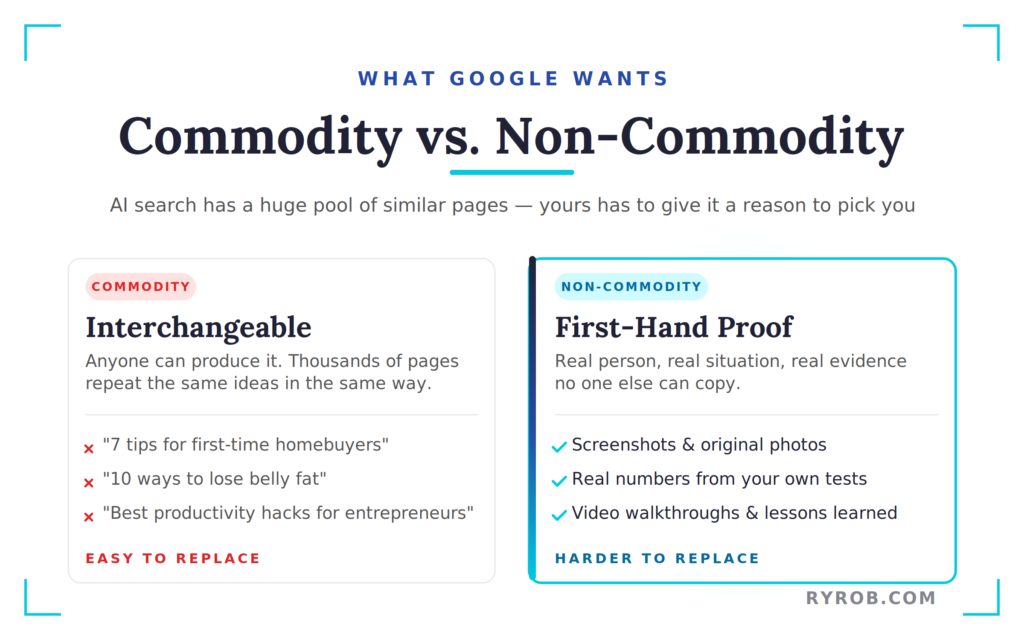
Non-commodity content material feels completely different straight away. It has an actual particular person behind it, an actual scenario, and proof that comes from expertise. As an alternative of one other generic home-buying ideas article, think about a put up about an actual provide on an actual home, together with the inspection tradeoff that saved cash and the shock difficulty present in an outdated sewer line.
That type of web page has texture, stakes, and particulars one other author can’t copy with out residing it. By prioritizing these specifics, you align with EEAT ideas and construct authority by way of genuine, useful content material.
AI search raises the bar as a result of it has a big pool of comparable pages to select from. In case your web page blends in, there is no such thing as a sturdy cause to make use of it.
In case your web page consists of screenshots, images, numbers, examples, classes discovered, or a video walkthrough, it turns into a lot simpler to justify as a supply. These parts give Google one thing concrete to reference.
In case your web page could possibly be written with out doing the work, seeing the end result, or studying the lesson, it’s seemingly too replaceable to face out in AI search.
That is additionally the place authentic video issues greater than most individuals assume. As search strikes towards multimodal AI, the power to course of and perceive video alongside textual content turns into extra necessary.
A helpful video paired with a powerful write-up offers you authentic proof property that generic weblog posts do not need. That mixture makes your content material more durable to switch.
For bloggers and creators, this can be a shift in precedence. Don’t begin with “what key phrase can I goal?” Begin with “what can I present that different pages can’t?” By specializing in distinctive worth, you strengthen your digital presence and make your content material extra seemingly for use in AI-driven outcomes.
The Technical Fundamentals That Nonetheless Matter Most
Google’s technical recommendation on this information stays grounded in a well-known technical search engine optimization construction. As a result of these foundations are already well-established, they’re nonetheless essentially the most dependable manner to make sure your content material is prepared for the way forward for search.
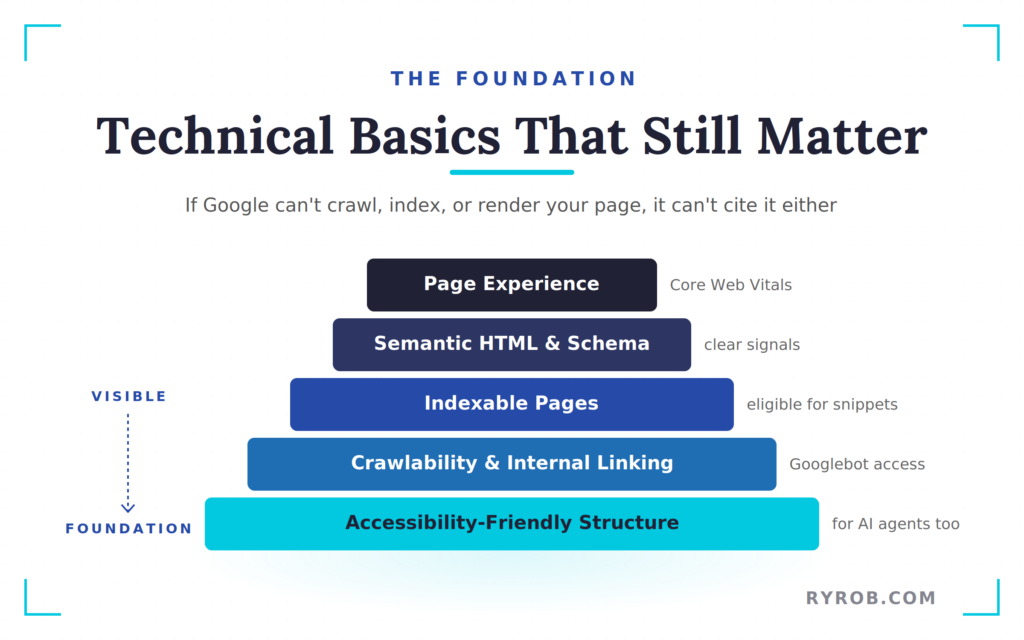
At a excessive stage, these fundamentals nonetheless matter most:
- Indexable pages and eligibility for search snippets
- Crawlability and Googlebot entry
- Semantic HTML, structured knowledge, and schema markup
- Web page expertise and Core Net Vitals
- Accessibility-friendly construction
First, pages should be indexable and eligible for search snippets. If Google can’t embody your web page in normal search outcomes, it can’t use that web page in AI-driven options both. This sounds primary, but many websites nonetheless hinder efficiency by burying precious data behind blocks that make crawling unnecessarily troublesome.
Subsequent is crawlability. If you would like a selected part of your website cited by an AI, you could be certain that Googlebot can entry it, which implies avoiding unintentional blocks, messy rendering, and complicated setups that cover your content material. Inner linking additionally helps bots navigate your website and ensures that your most related pages stay discoverable.
With regards to formatting, Google emphasizes the worth of semantic HTML. You don’t want excellent, error-free code, however you do want a transparent construction with correct headings and web page sections. Structured knowledge and schema markup present express indicators that assist engines like google perceive the context of your data.
Web page expertise additionally stays a prime precedence. Your website needs to be mobile-friendly and quick, since a optimistic consumer expertise retains readers engaged. Core Web Vitals ought to keep in your common upkeep guidelines as a result of they help stability and usefulness.
Google additionally highlights how AI brokers work together together with your content material, pointing towards accessibility-friendly construction. Writing clear code that works nicely with display readers additionally helps automated shopping instruments parse your data extra precisely.
For many creators, this isn’t a cause to panic or rebuild your website from scratch. These steps are merely an extension of present finest practices designed to maintain your website optimized as search continues to evolve.
The AI search engine optimization Myths Google Says You Can Cease Worrying About
This a part of the information is essentially the most satisfying as a result of Google instantly addresses among the loudest claims available in the market.
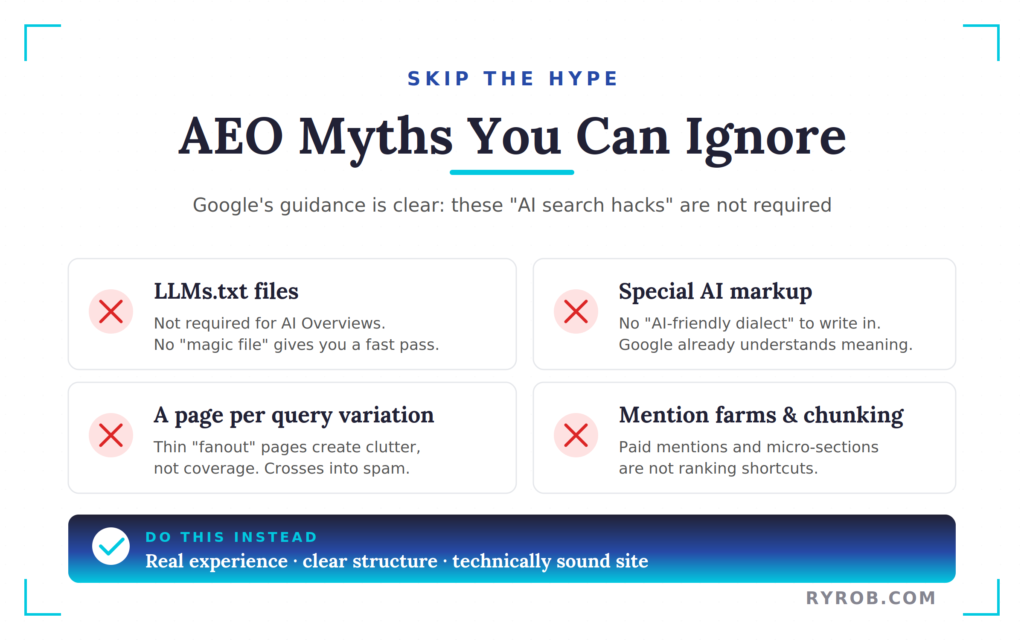
Lots of people have repackaged odd search recommendation into Generative Engine Optimization, or AEO, and offered it at a premium. Google’s message is obvious: a lot of these add-ons are elective, and a few are a waste of time.
You Do Not Want LLMs.txt Information or Particular AI Markup
If somebody is attempting to promote you a magic file for AI visibility, decelerate.
Google says you do not want new machine-readable recordsdata, particular AI textual content markup, or markdown tips to look in AI Overviews. That instantly cuts by way of a whole lot of pointless complexity.
You don’t want an LLMs.txt file as a quick cross into search outcomes. If it helps your inner Giant Language Fashions workflow, that’s effective, however Google doesn’t require it for visibility.
You Do Not Must Rewrite Content material for Each Potential Question Variation
Google additionally pushes again on the concept that you should rewrite content material in some AI-friendly dialect.
Its methods already perceive which means, synonyms, and associated phrasing, so you do not want dozens of barely completely different variations of the identical paragraph. You additionally don’t want a separate web page for each minor long-tail variation.
That type of content material inflation creates muddle as a substitute of protection. It weakens your website and may cross into spam when the aim is to sport rankings relatively than assist customers.
In case your web page solutions the principle drawback clearly, covers key subtopics, and consists of actual proof, Google can do the remainder.
Schema, Chunking, and Point out Farms Are Not Magic Fixes
Schema markup nonetheless has a spot. In case you are publishing recipes, merchandise, or articles, hold utilizing the proper tags, however it isn’t a hidden AEO shortcut.
The identical applies to content material chunking. Clear construction helps, however slicing content material into micro-sections is just not a rating trick and doesn’t robotically enhance AI-readability.
Pretend authority constructing additionally doesn’t maintain up. Paying for random mentions, dropping hyperlinks into irrelevant threads, or utilizing point out farms might appear like traction, however Google’s spam methods are constructed to catch it.
Instruments nonetheless have worth once they help analysis, outlining, and enhancing. These best AI tools to optimize search content can save time, however they can not flip weak concepts into useful content material that individuals truly need to cite.
A Sensible Workflow for Creating Content material That Can Rank in AI Search
That is the place the information turns into helpful in each day work. The most important shift is just not what you do whereas formatting a web page, however what you resolve earlier than the web page exists.
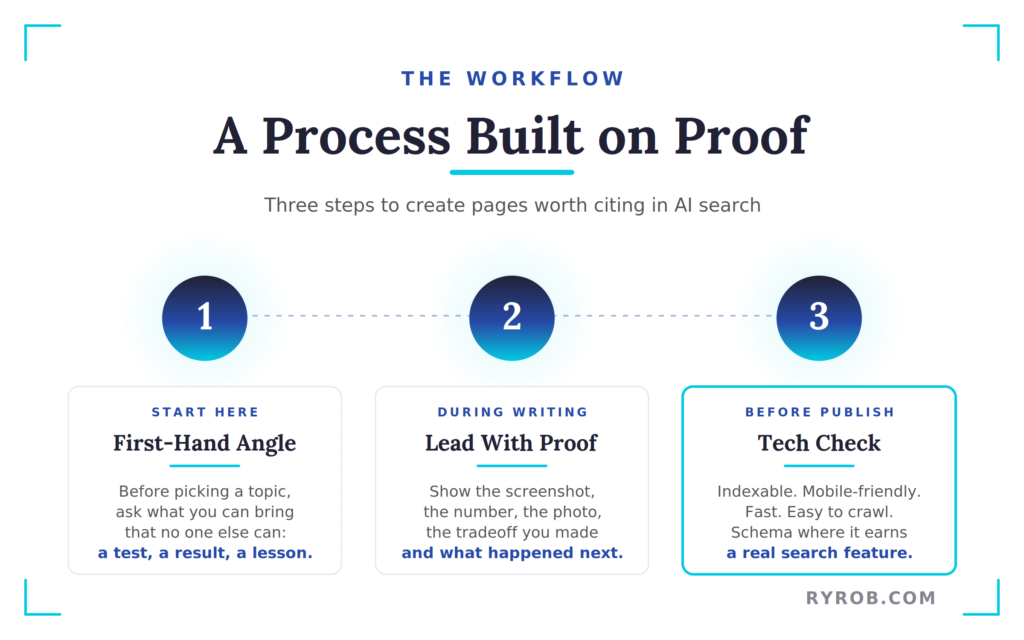
A greater workflow begins earlier, asks more durable questions, and places proof on the middle.
1. Begin With First-Hand Expertise Earlier than You Choose the Subject
Earlier than you write a phrase, ask what first-hand angle you’ll be able to convey that one other website can’t. That is important for constructing topical authority in your area of interest, and it may come from a venture you ran, a take a look at you accomplished, a failure you discovered from, or a consumer end result you’ll be able to present.
A easy filter helps right here: when you may produce the piece with out doing the factor, residing it, or observing the end result up shut, it’s in all probability not sturdy sufficient. That shift additionally modifications how you intend matters, transferring you away from remoted key phrases and towards actual experiences mapped to look demand.
By organizing these experiences into content material hubs and utilizing inner linking, you assist engines like google perceive the depth of your experience. Understanding entity mapping additionally clarifies how Google connects your matters to broader trade themes.
2. Construct the Web page Round Proof, Not Fluff
When you select the subject, lead with proof. Use the screenshot, present the quantity, embody the photograph, quote the e-mail, and clarify the tradeoff you made and what occurred subsequent.
These particulars flip a generic article right into a helpful web page and provides your content material one thing actual that AI methods can reference. The identical applies to video, the place a powerful walkthrough or demo on YouTube, paired with written context, provides authentic proof that generic pages lack.
Write in a pure voice and use headings so the web page is simple to scan, however keep away from forcing it into a synthetic AI format. If it reads like a transparent rationalization you’d give to a pal, you’re heading in the right direction.
3. Examine Technical Fundamentals Earlier than You Publish
Technical evaluate nonetheless belongs on the finish, but it surely ought to keep in its lane. Earlier than publishing, be sure your technical search engine optimization construction is sound by checking that the web page is indexable, mobile-friendly, quick sufficient, and straightforward to crawl.
Use schema when it helps the web page earn the appropriate search options, and skip it when it is just being added for a perceived AI enhance. Then learn the introduction once more and ask if it units a transparent expectation that the web page will ship actual worth.
If the reply is sure, publish it. If not, the problem isn’t a lacking AI tag, however that the content material nonetheless feels generic.
FAQs About search engine optimization for Generative AI
Beneath are further questions you is perhaps interested in.
Is search engine optimization Nonetheless Related for Generative AI Search?
Sure, search engine optimization continues to be related for generative AI search. Google’s place is obvious on this level, as its generative AI options nonetheless rely on core search rating and high quality methods, making conventional search engine optimization the bottom layer for achievement in an period more and more outlined by conversational search.
Do I Want an LLMs.txt File to Present Up in AI Outcomes?
No, you do not want an LLMs.txt file to indicate up in AI outcomes. Google says you do not want particular machine-readable recordsdata or new AI markup simply to look in generative AI search options.
Ought to I Create a Separate Web page for Each Fanout Question?
No, you shouldn’t create a separate web page for each fanout question. Cowl the subject nicely sufficient that your web page can help associated questions naturally, and deal with semantic readability to deal with varied consumer intents with out mass-producing skinny pages that may damage your website’s authority.
What Kind of Content material Has the Greatest Probability of Being Cited?
Content material that demonstrates sturdy EEAT ideas has the most effective likelihood of being cited. First-hand expertise, authentic proof, and clear construction, together with screenshots, actual numbers, authentic images, video, and sincere evaluation, make a web page a lot more durable for AI methods to switch.
Will Zero-Click on Search Impression My Visibility?
Sure, zero-click search can affect your visibility, however it isn’t solely new. Generative AI might change how customers work together with outcomes, so deal with turning into the first supply of fact to your subject, the place distinctive worth encourages customers to click on by way of for full context.
Do I Must Optimize for AI Brokers Proper Now?
No, most websites don’t have to optimize for AI brokers proper now. Clear construction, accessibility, semantic HTML, and good web page expertise already put you in a powerful place, and incorporating real-time monitoring helps hold your content material related as AI methods evolve.
Remaining Ideas on search engine optimization for Generative AI Search
Google didn’t kill optimization for AI solutions. It merely eliminated the concept that you want a separate bag of tips to compete there, and as a substitute factors again to the basics behind Generative Engine Optimization.
The pages almost definitely to win in AI search are nonetheless those that earn belief by way of authentic content material, clear construction, and constant utility of EEAT ideas. By protecting your website simple for Google to crawl and stuffed with distinctive worth, you defend your natural visitors and construct a resilient digital presence.
Search might look completely different on the floor, however the work that issues nonetheless comes from creating high-quality, authoritative content material that others can’t simply copy.