
Commercial

This Submit is dropped at you by Semrush.
The content material advertising and marketing playbook is getting rewritten.
Whilst you pump out article after article, good manufacturers are doing the other—and seeing higher outcomes.
They’re publishing much less however rating larger.
The info backs this up: websites with 5,000+ pages typically battle with indexing points, low engagement, and weak authority.
In case you’re managing a web site with hundreds of pages that hardly rank, you’re not dealing with a content material drawback: you’re dealing with a technical website positioning disaster.
The “publish day by day” technique has left you with a bloated web site the place Google refuses to index most of your content material.
Your crawl budget (the restrict on what number of pages Google will go to in your web site) will get wasted on skinny articles, and your web site authority spreads so skinny that nothing ranks nicely.
However right here’s the excellent news: you may repair this.
Strategic content pruning (eradicating low-value pages) mixed with technical prognosis can reduce your web page rely by 70% whereas enhancing natural visitors.
Websites that make this shift see sooner indexing, higher rankings, and concentrated authority on their finest content material.
This text focuses on one factor: diagnosing and fixing the amount lure for websites drowning in hundreds of underperforming pages.
Key Takeaways
|
Why Extra Content material Hurts Rankings |
||
|
Publishing Quantity Hurts Rankings Websites with hundreds of pages typically endure from indexing gaps, wasted crawl price range, and diluted authority.
Publishing much less however higher content material persistently outperforms high-volume methods. |
||
|
Google limits what number of pages it is going to go to in your web site, that means skinny or low-quality pages eat price range that ought to go to your finest content material. |
||
|
Semrush Web site Audit Is the Beginning Level Operating a web site audit reveals the precise pages inflicting technical harm — skinny content material, duplicate points, damaged hyperlinks, and orphaned pages — earlier than you make any pruning selections. |
||
|
4-Bucket Framework Guides Each Resolution Pages ought to be categorized as Maintain and Optimize, Consolidate, Delete, or Redirect based mostly on visitors, engagement, backlink knowledge, and technical well being. |
||
|
Content material Pruning Can Reduce Web page Depend by 70% Whereas Rising Visitors Websites that take away low-value pages see sooner indexing, higher rankings, and concentrated authority on their strongest content material. |
||
|
Deletion Is Not At all times the Reply Pages with visitors historical past or backlinks ought to be redirected utilizing 301 redirects reasonably than deleted outright, preserving their hyperlink authority. |
||
|
Semrush Content material Toolkit Handles Enchancment at Scale Semrush’s Content material Optimizer, Matter Finder, and website positioning Transient Generator work collectively to enhance a whole lot of present pages with out sacrificing model voice or requiring a big writing group. |
||
|
Prevention Requires the Similar Instruments The amount lure recurs with out upfront validation. Operating Matter Finder earlier than project and Content material Optimizer on drafts earlier than publishing stops low-quality pages from ever going reside. |
||
However first, let’s discuss concerning the Quantity Lure.
The Quantity Lure: When Extra Content material Hurts Your Rankings
Google doesn’t reward you for publishing extra. It rewards you for publishing higher.
While you flood your web site with content material, you create technical issues that damage rankings as a substitute of serving to them.
Give it some thought this manner: you wouldn’t add extra rooms to a home with a cracked basis, proper?
However that’s precisely what occurs when content material groups preserve publishing with out fixing present technical points.
The amount lure creates the next points:
1. Indexing issues.
Google offers each web site a crawl price range—a restrict on what number of pages it is going to go to and index.
When you could have hundreds of pages, Google picks and chooses what to index.
Websites with hundreds of URLs face this continually.
You publish article after article, however solely a fraction reveals up in search outcomes.
2. Wasted crawl price range.
Your crawl price range will get spent on skinny content material (pages with inadequate textual content for Google to know the subject) as a substitute of your finest work.
Each low-quality web page Google crawls is one much less high-quality web page it discovers.
3. Diluted authority.
Web site authority spreads throughout hundreds of URLs till nothing ranks nicely.
It’s like making an attempt to mild a room with one candle versus concentrating that very same mild with a targeted beam.
4. Poor engagement indicators.
Your analytics inform the actual story.
Common time on web page drops.
Bounce charges climb.
Customers land on rushed, generic content material and go away instantly.
These engagement indicators inform Google your content material doesn’t present worth, which hurts rankings throughout your total web site.
The sample reveals up all over the place: 80% of your visitors comes from 20% of your pages.
The opposite 80% of pages sit there losing sources and offering nearly zero worth.
This isn’t a philosophical debate about content material high quality vs amount—it’s a visitors actuality backed by your personal analytics.
While you’re racing to hit publishing quotas, high quality drops.
Writers produce skinny content material that checks website positioning containers however lacks depth.
These pages don’t simply fail to rank—they actively damage your web site’s efficiency.
Diagnosing Your Quantity Drawback: Step-by-Step with Web site Audit
Most content material groups strategy the amount drawback backwards: they attempt to repair it by creating higher content material.
However should you’re sitting on hundreds of low-quality pages, creating extra content material—even nice content material—doesn’t remedy the technical issues dragging your web site down.
It’s essential to diagnose the harm first.
That is the place Semrush’s Site Audit turns into important.
It’s a robust web site crawler that performs over 140 technical website positioning checks, exhibiting you precisely the place the amount lure is hurting your web site.
Setting Up Your First Audit
Step 1: Create your audit marketing campaign.
Navigate to Web site Audit from the left menu in Semrush, below website positioning On Web page & Tech part (additionally obtainable below AI Visibility).
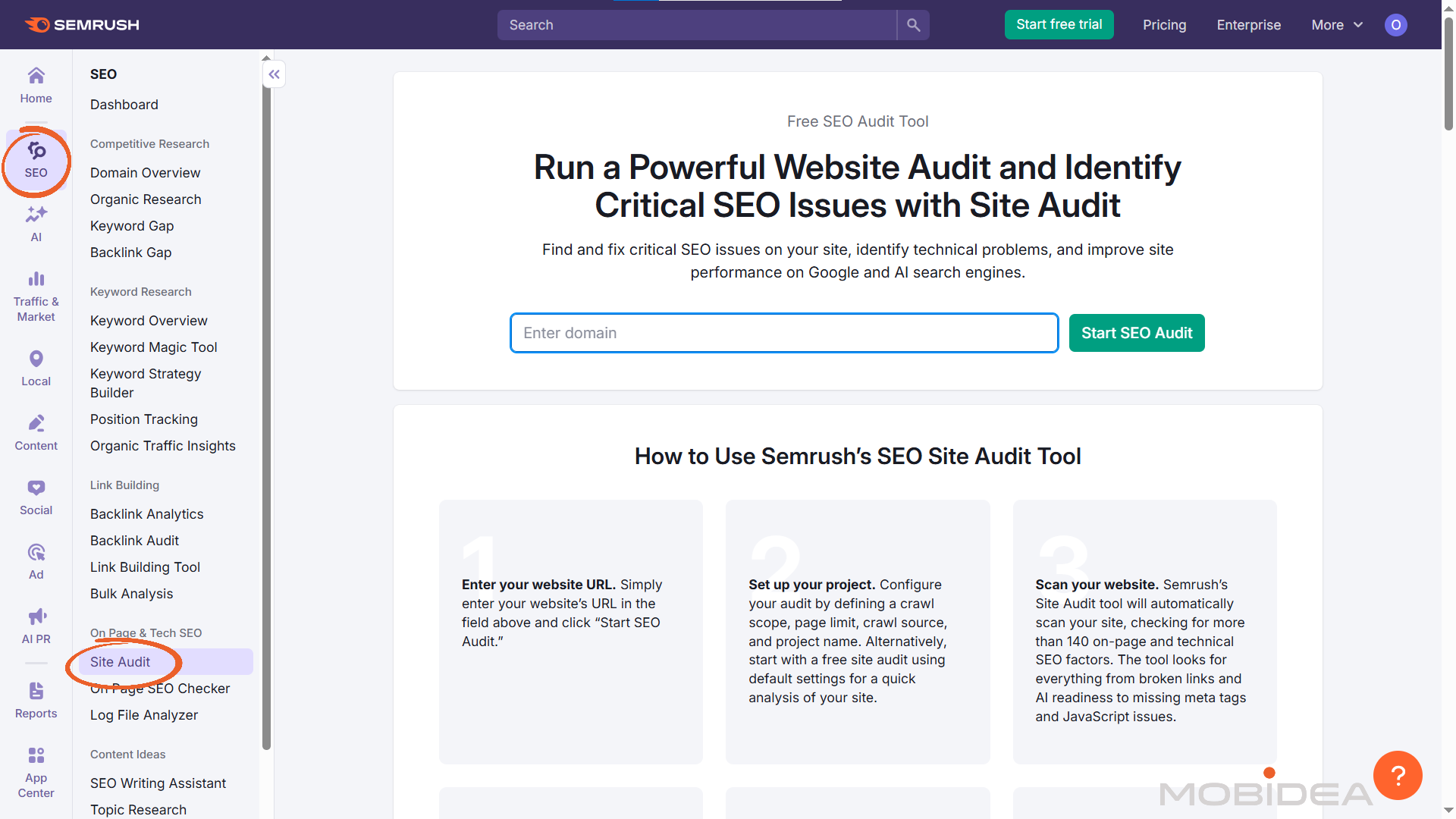
Place your area and click on on Begin website positioning Audit.
If that is your first audit, it is going to robotically configure while you create a folder.
For subsequent audits, click on “Create new mission” and enter your area.
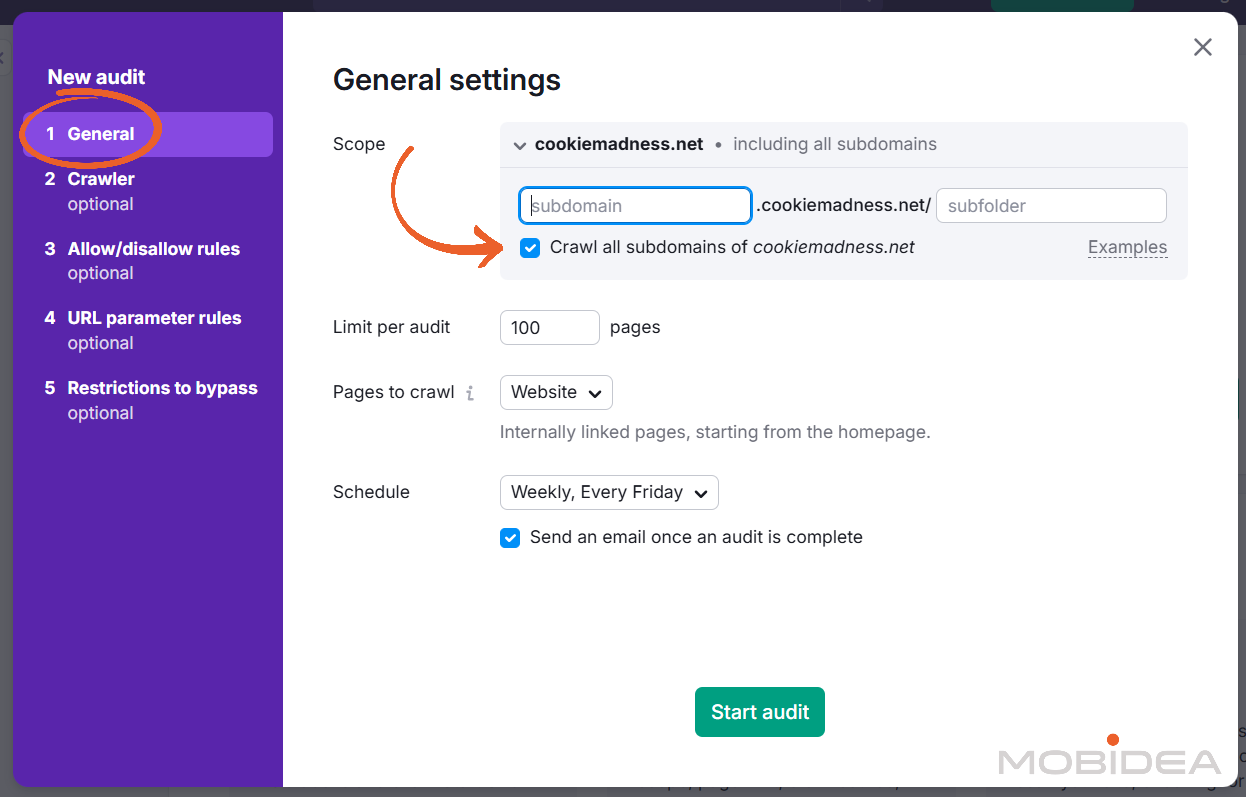
Step 2: Configure your crawl scope.
Within the Normal Settings pop-up wizard, determine what to audit:
- Root area (consists of all subdomains and subfolders)
- Particular subdomain (e.g., weblog.yoursite.com)
- Particular subfolder (e.g., yoursite.com/weblog/)
For diagnosing quantity issues, begin together with your root area to see the total image.
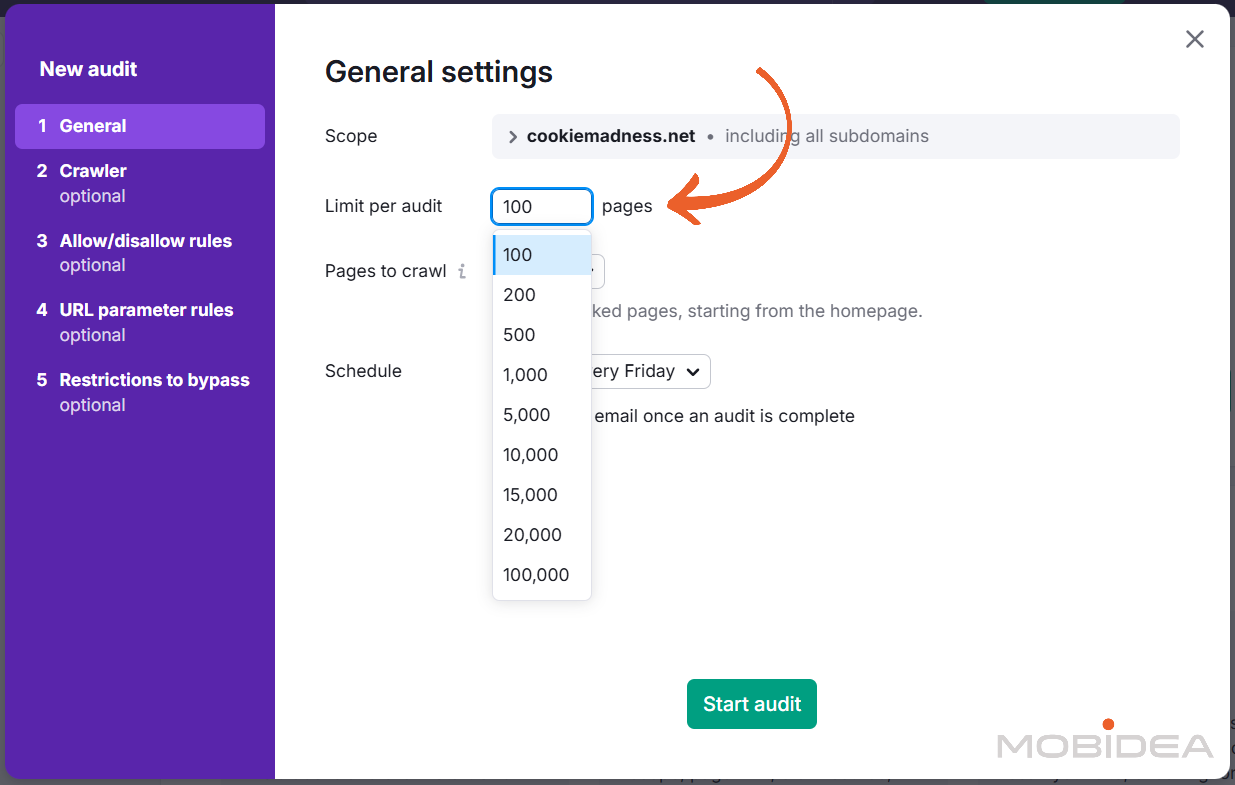
Step 3: Set your web page restrict.
Select what number of pages to crawl per audit based mostly in your subscription:
- Professional: as much as 20,000 pages per audit
- Guru: as much as 20,000 pages per audit
- Enterprise: as much as 100,000 pages per audit
In case you have extra pages than your restrict permits, the crawler will prioritize pages it finds first by your web site’s inner linking construction.
Free accounts can crawl as much as 100 pages.
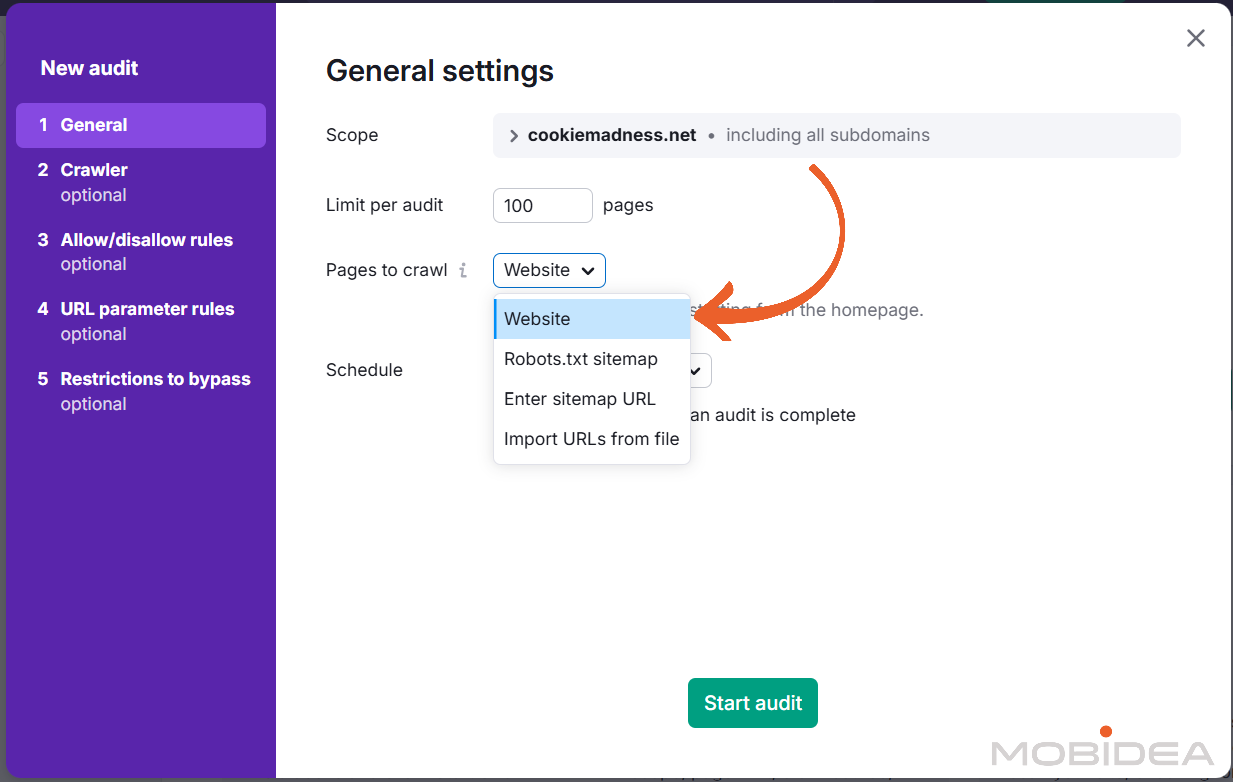
Step 4: Select your crawl supply.
You’ve 4 choices:
- Web site (crawls like Google, following hyperlinks out of your homepage)
- txt sitemap (makes use of the sitemap linked in robots.txt)
- Sitemap by URL (enter your particular sitemap URL)
- File of URLs (add a .csv or .txt file with particular URLs to examine)
For quantity lure prognosis, “Web site” offers you probably the most reasonable view of what Google sees.
Step 5: Schedule your audit.
Select weekly, each day, or one-time crawl.
For preliminary prognosis, choose “As soon as.”
You may all the time re-run it after making modifications.
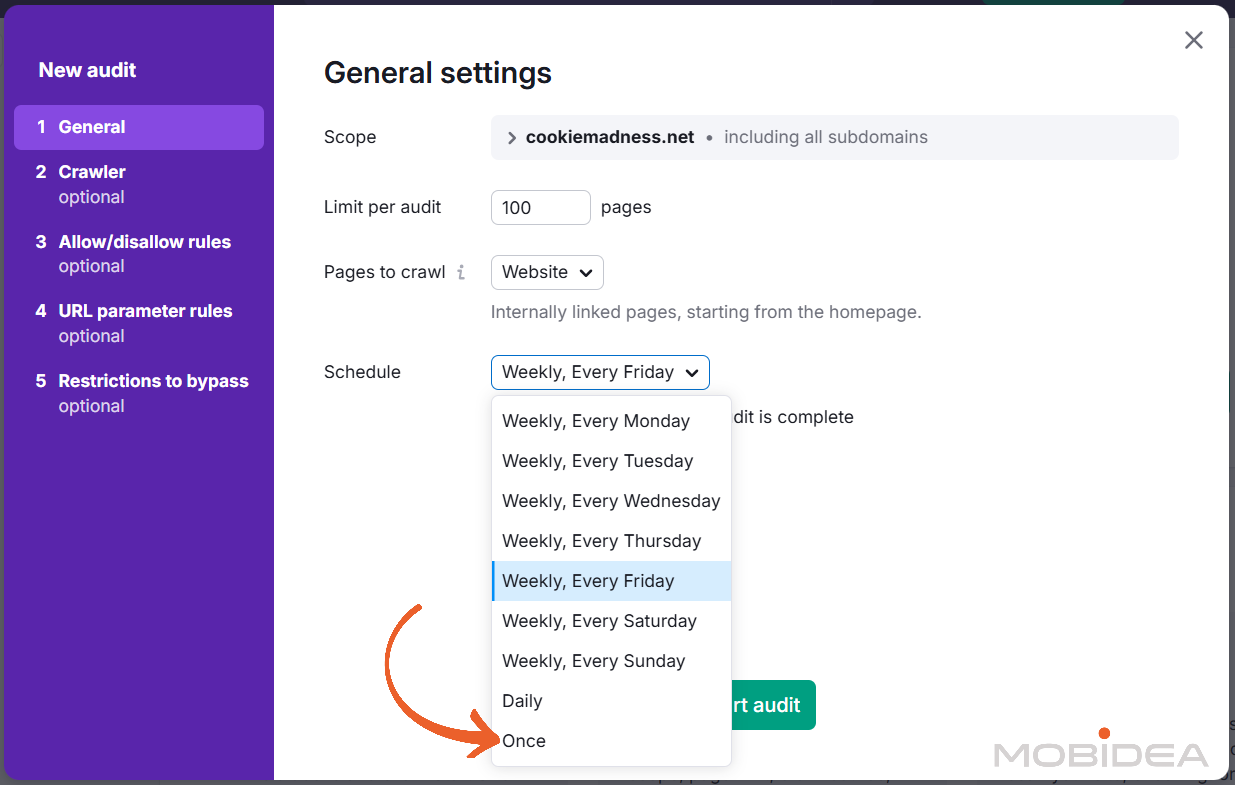
Click on “Begin audit” and Web site Audit will start crawling.
Be aware: You can too edit different settings comparable to crawler settings (helpful to keep away from getting blocked by your personal web site), Enable/Disallow (for crawling or not crawling particular pages), and so forth.
For giant websites, this course of can take 15-Half-hour.
Studying Your Audit Outcomes
As soon as the crawl completes, you’ll see the Overview report. Right here’s what issues for quantity lure prognosis:
Web site Well being Rating.
This share (0-100%) displays the density of issues in your web site.
A rating under 80% sometimes signifies critical points.
The rating considers each errors (extreme points proven in pink) and warnings (medium severity points proven in orange).
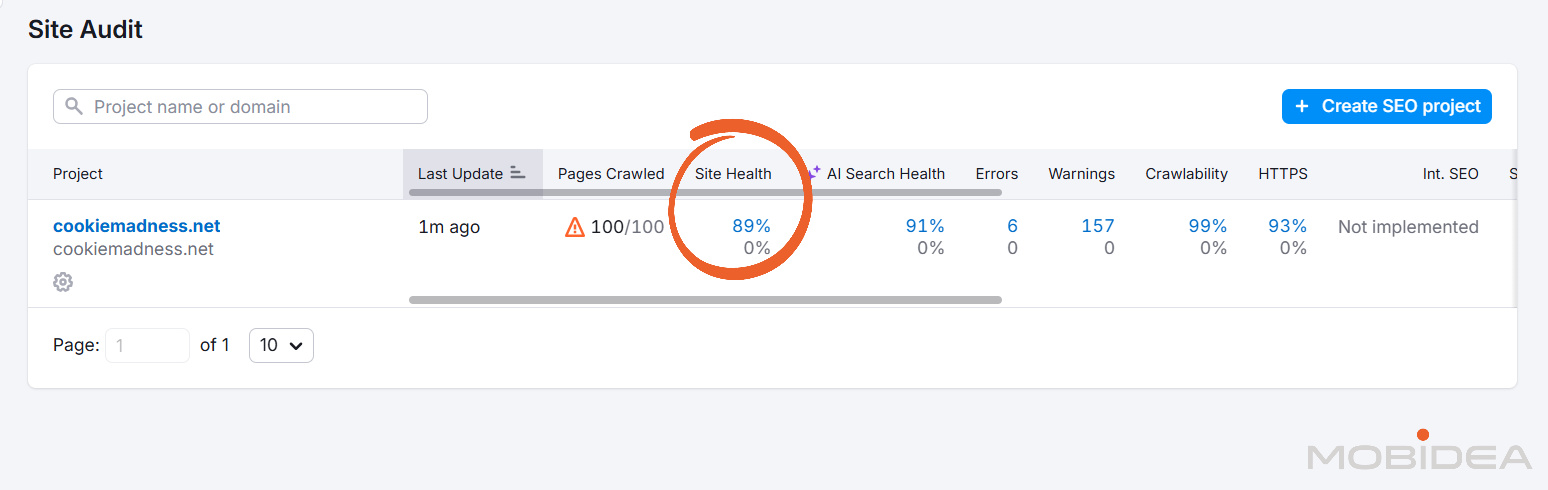
High Points by severity.
The report reveals your largest issues first.
For quantity lure websites, you’ll generally see:
- Pages with skinny content material (low textual content to HTML ratio and low phrase rely)
- Duplicate content material points
- Damaged inner hyperlinks
- Pages with no incoming inner hyperlinks (orphaned pages)
- Sluggish web page load occasions
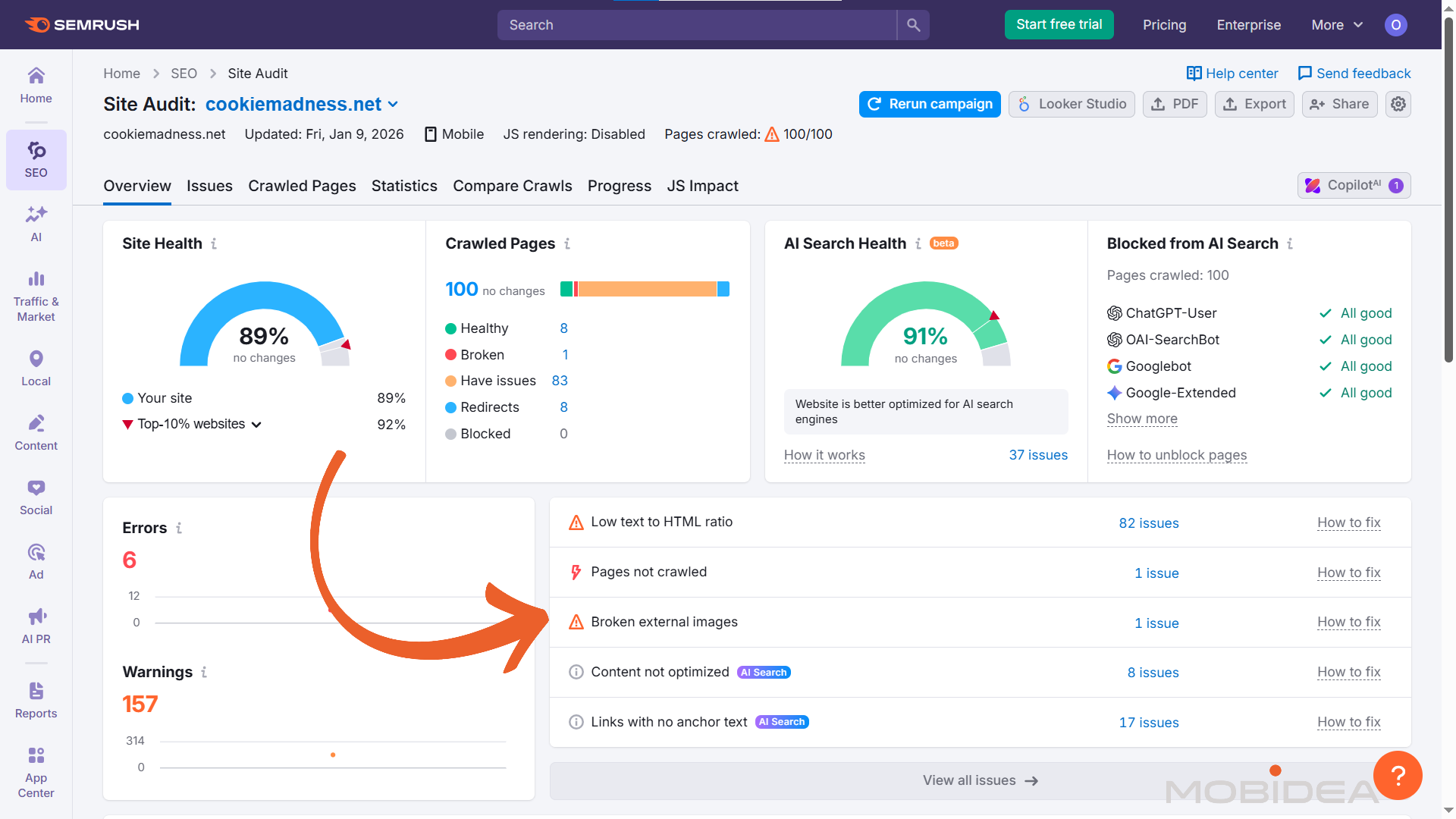
Crawled Pages breakdown.
This reveals what number of pages are wholesome, damaged, having points, redirects, or blocked.
In case you see numerous “pages with points,” that’s your poisonous mass.
Discovering Your Drawback Pages
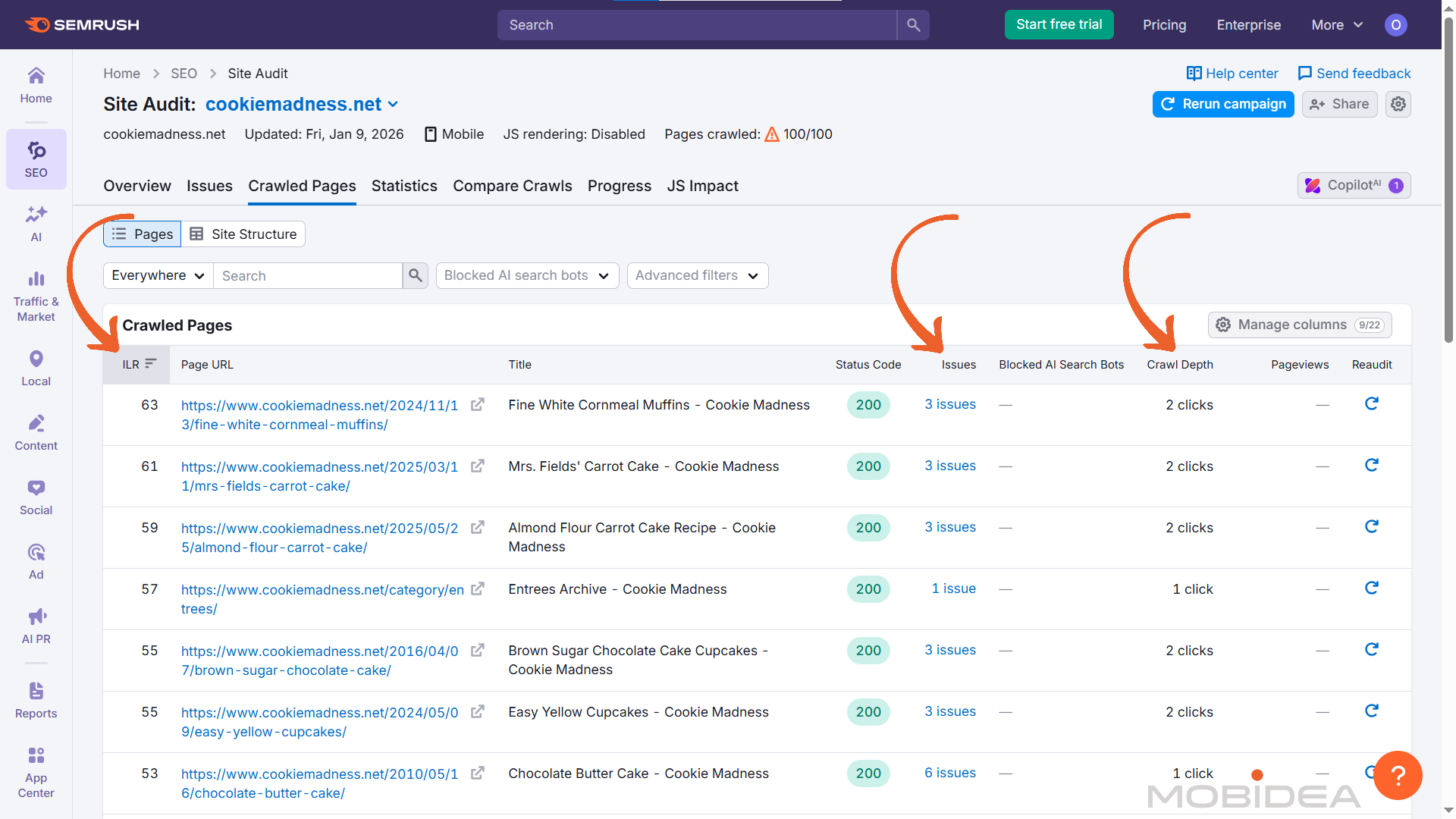
Click on on “Crawled Pages” tab.
This report lists each URL Web site Audit discovered, together with important metrics:
That is based mostly on incoming inner hyperlinks and crawl depth (what number of clicks from the homepage).
Pages with larger ILR are extra accessible and sometimes extra vital.
This reveals what number of clicks out of your homepage to achieve this web page.
Something over 3 clicks is tough for customers and search engines like google to search out.
What number of issues this particular web page has.
In case you join Google Analytics, you may see which pages truly get visitors.
Use filters to determine drawback pages:
- Click on “Superior filters” on the high of the desk
- Add filter: “Standing” = “Pages with points”
- Add filter: “Inner LinkRank” > 70 (finds vital pages with issues)
- Type by “Distinctive pageviews” to repair high-traffic pages first
This filtered view reveals you which of them vital pages want consideration.
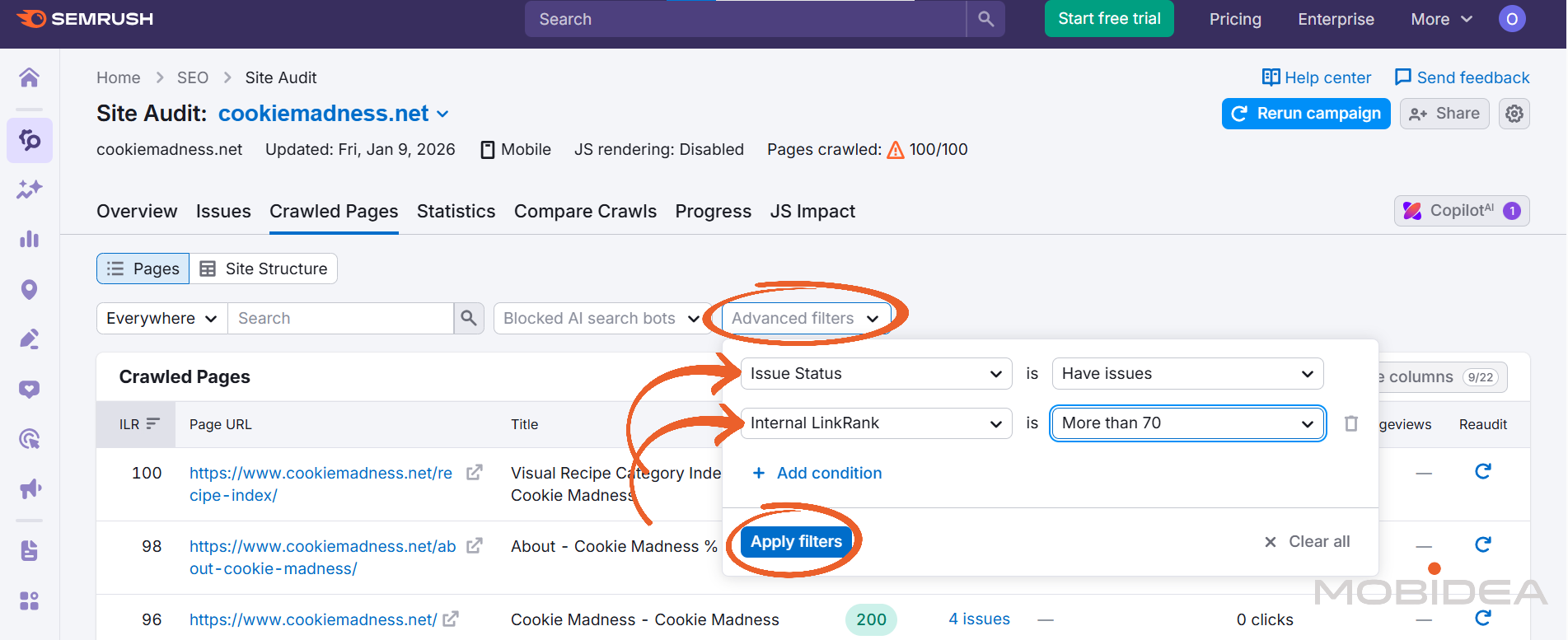
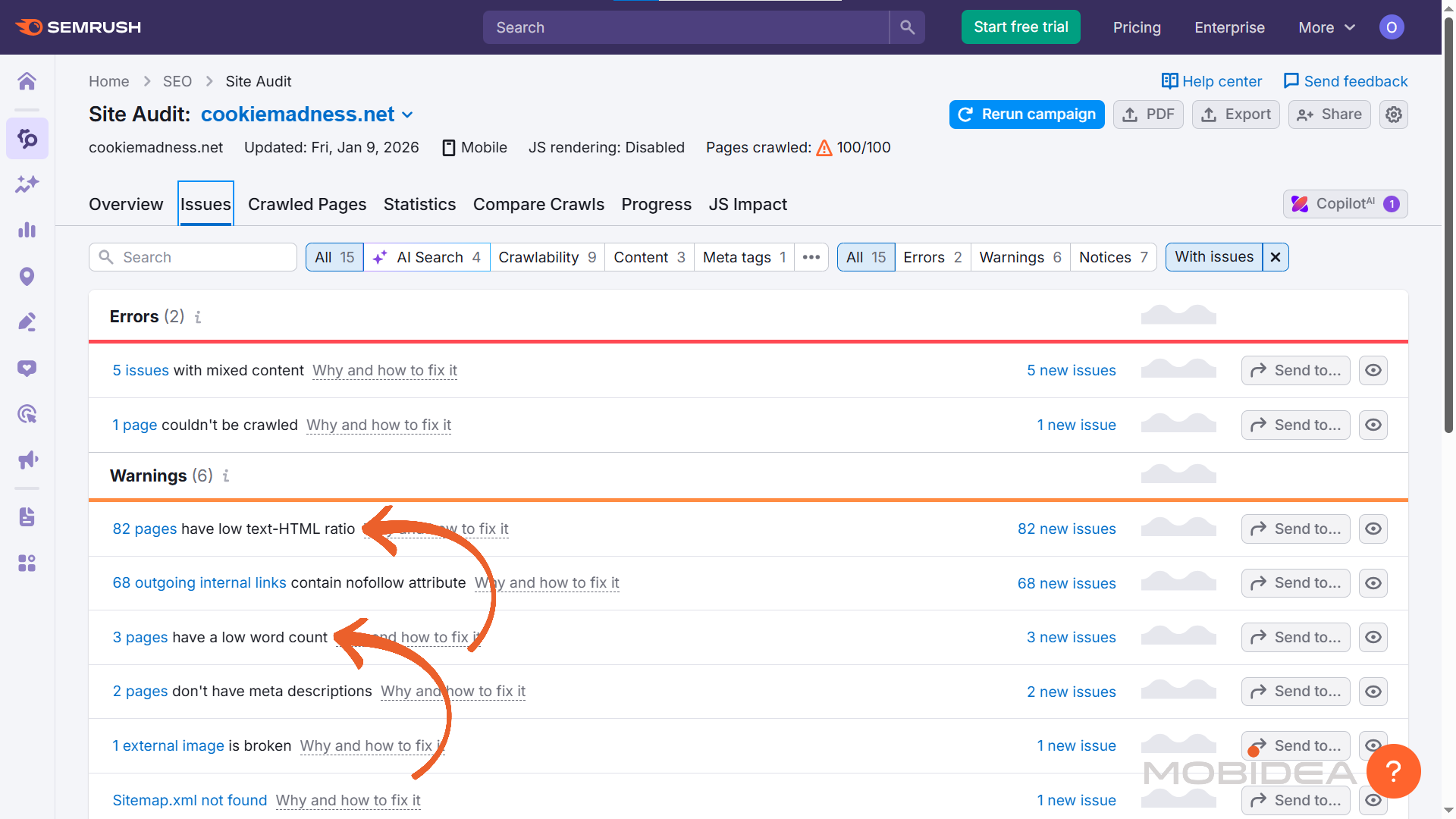
To search out skinny content material particularly:
- Go to the “Points” tab
- Search for “Low phrase rely” within the warnings listing (I additionally like wanting into pages with low text-HTML ratio)
- Click on on the quantity to see all pages with skinny content material
- Export this listing in your pruning selections
Exporting Information for Evaluation
It’s essential to mix Web site Audit knowledge together with your Google Analytics visitors knowledge to make good pruning selections.
From Web site Audit: Click on the export button (high proper) and choose:
- “Crawled Pages” – offers you all URLs with their technical metrics
- “Crawled Pages with Points” – features a column for each potential concern
Export as Excel or CSV format.
From Google Analytics: Export 12 months of information together with:
- URL
- Periods
- Common time on web page
- Bounce charge
- Conversions (if relevant)
Mix the information.
Use Excel’s VLOOKUP or Google Sheets to merge Web site Audit metrics with visitors knowledge.
This provides you a whole image: technical well being plus precise efficiency.
Now you may kind to search out:
- Pages with zero visitors and a number of technical points (deletion candidates)
- Pages with good visitors however fixable technical issues (optimization targets)
- Pages with low visitors and excessive crawl depth (consolidation candidates)
Nevertheless, you may make this a complete lot simpler by merely connecting your Google Analytics to Semrush Site Audit.
What Web site Audit Reveals About Your Quantity Drawback
To summarize, for high-volume websites, Web site Audit sometimes reveals:
Inadequate textual content for Google to know the subject.
Usually these are posts rushed to satisfy publishing quotas—200-300 phrases that hardly scratch the floor.
Google sees a number of pages as copies of one another, diluting authority.
Perhaps you could have 5 weblog posts protecting related subjects with out including new insights.
Hyperlinks pointing to non-existent pages, losing crawl price range and making a poor person expertise.
In case you have 5,000 pages however Web site Audit solely discovered 3,000, that hole reveals pages Google can’t uncover by your inner linking construction.
Excessive bounce charges and low time on web page point out content material that doesn’t meet person wants.
Every of those technical issues hyperlinks again to high-volume publishing that prioritized amount over high quality.
The excellent news? You now have the information to repair it systematically.
Enhancing Content material at Scale: The Strategic Infrastructure Strategy
Web site Audit informed you what’s damaged.
Now that you must repair it effectively with out hiring 20 writers or shedding your genuine voice.
That is the place Semrush’s Content Toolkit turns into your strategic content material infrastructure.
The standard-vs-scale paradox appears to be like not possible: you could have a whole lot of pages that want enchancment, however you may’t afford to rewrite every little thing from scratch, and you may’t use generic AI content material that loses your model voice.
Content material Toolkit solves this by combining data-driven planning with AI-assisted execution that preserves your experience.
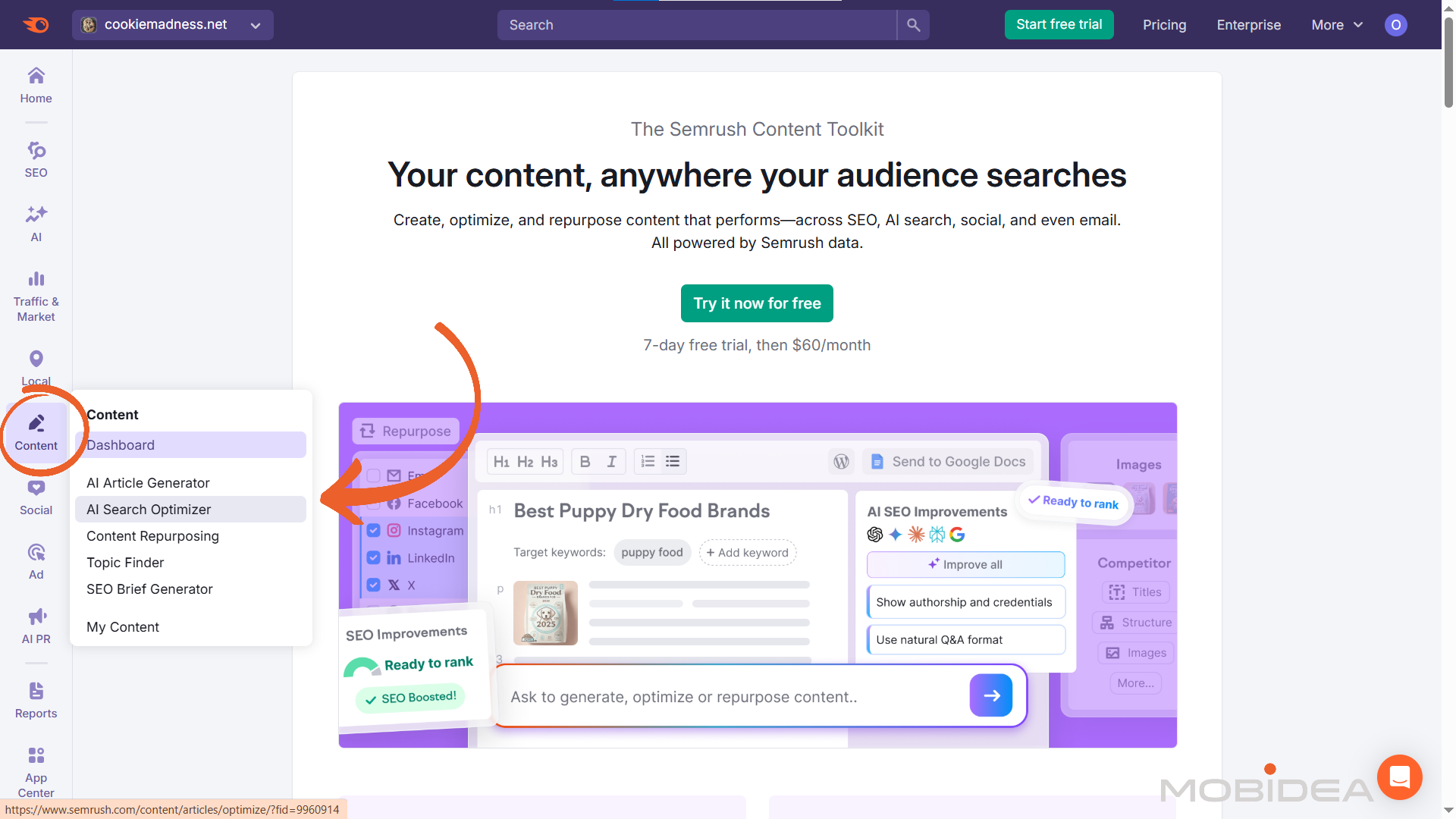
Enhance Current Content material at Scale
Content material Optimizer is particularly designed to enhance present content material at scale whereas sustaining your genuine voice.
That is the instrument that transforms your “preserve and optimize” listing from Web site Audit into better-performing pages.
The way it works for quantity lure restoration:
Step 1: Add your present content material.
Take a web page Web site Audit flagged as skinny or underperforming.
Go to Content material Optimizer within the Content material Toolkit (left menu).
Paste your present content material immediately into the editor.
Step 2: Set your goal key phrases.
Add not less than three goal key phrases (the phrases you need this web page to rank for) and choose your viewers location.
The instrument will spotlight these key phrases all through your draft so you may see the place they seem.
Step 3: Get your efficiency scores.
Content material Optimizer robotically analyzes your content material throughout three areas:
- website positioning rating: Key phrase protection, metadata, alt tags, and topical relevance (the subjects search engines like google count on to see lined)
- Readability rating: Sentence size, construction, and ease of studying (important for non-native English audio system)
- Tone of voice rating: How nicely your content material matches your model voice
Every space will get a rating from 0-100. You’ll immediately see what wants fixing.
Step 4: Overview particular solutions.
The instrument supplies detailed suggestions based mostly on top-ranking opponents:
- Lacking key phrases you must add
- Alt texts (descriptions for photographs) which might be lacking
- Readability points like overly lengthy sentences
- Tone inconsistencies that drift out of your model voice
Step 5: Apply AI-powered enhancements.
That is the place the instrument preserves your voice whereas fixing issues.
Click on any sentence or paragraph and select:
- Rewrite: Enhance readability whereas holding your level
- Simplify: Make complicated concepts simpler to know
- Increase: Add extra element the place content material is just too skinny
- Summarize: Condense lengthy paragraphs
- Make an inventory: Flip dense textual content into scannable bullet factors
In contrast to generic AI rewriting, these enhancements keep your experience and perspective—they only repair the technical and readability points.
Step 6: Watch your scores enhance in real-time.
As you apply enhancements, your website positioning, readability, and tone scores replace instantly.
You may see progress as you’re employed, realizing precisely while you’ve hit your targets.
Step 7: Add content material the place wanted.
Use the built-in AI Chat to increase skinny sections.
For instance, if Web site Audit flagged a web page as having low phrase rely (below 300 phrases when opponents have 1,500), you may ask the AI to assist increase particular sections when you keep management over the experience and voice.
Step 8: Evaluate with opponents.
The Competitor Information tab reveals you ways your improved content material stacks up in opposition to top-ranking pages.
You may determine any remaining gaps earlier than finalizing.
Step 9: Optimize for AI search.
Content material Optimizer consists of an AI website positioning tab that checks 5 particular components:
- Readability and summarization (can AI instruments simply digest and cite your content material?)
- E-E-A-T indicators (Expertise, Experience, Authoritativeness, Trustworthiness)
- Q&A format (does your content material immediately reply questions?)
- Part construction (clear headings and logical movement)
- Structured knowledge (schema markup that helps machines perceive your content material)
Click on “Examine for enhancements” and apply solutions to make your content material extra seen in AI-powered search instruments like ChatGPT and Google’s AI Overviews.
Step 10: Export or publish.
While you’re completed, you may:
- Publish on to WordPress
- Export to Google Docs
- Share a read-only hyperlink together with your group
Validate What’s Value Enhancing
Earlier than you spend time enhancing a whole lot of pages, validate which subjects even have search demand.
Matter Finder helps you determine which content material deserves the funding.
Easy methods to use it:
Enter a broad matter associated to your content material class (like “e-mail advertising and marketing”).
Matter Finder generates matter solutions with actual website positioning knowledge:
- Search quantity (precise demand)
- Key phrase issue (how arduous it’s to rank)
- Search intent (what customers are in search of)
- Associated questions customers ask
For quantity lure restoration:
Take your “preserve and optimize” listing from Web site Audit.
Run the primary subjects by Matter Finder.
You’ll shortly uncover:
- Pages protecting subjects with zero search demand (transfer these to “delete” as a substitute of losing enchancment time)
- Pages protecting high-demand subjects that justify your enchancment funding
- Associated subtopics that may rework skinny content material into complete guides
This prevents you from enhancing content material no person searches for.
One group can reduce their enchancment listing from 500 pages to 150 pages price investing in, saving months of labor.
Create Enchancment Plans
For pages that want important growth (like when Web site Audit reveals phrase rely below 500 when opponents have 2,000+), you want a transparent enchancment plan.
website positioning Transient Generator (nonetheless below the Content material Toolkit) analyzes top-ranking opponents and creates a data-driven transient exhibiting precisely what so as to add.
The transient consists of:
- Goal phrase rely based mostly on what ranks
- Secondary key phrases to incorporate (associated phrases that spherical out the subject)
- Full content material define with steered H2 and H3 headings
- Title and meta description solutions
- Competitor reference hyperlinks
For enhancing skinny content material:
Enter the key phrase your web page targets.
The instrument generates a quick exhibiting what profitable opponents cowl that you just’re lacking.
This transforms “make this higher” into particular, actionable enhancements like:
“increase from 400 to 1,200 phrases, add sections on X and Y, embody these secondary key phrases naturally.”
You may export the transient to share with writers, or click on “Generate website positioning article” to create a draft you may then refine in Content material Optimizer.
The Strategic Pruning Playbook: From Prognosis to Restoration
Content material pruning isn’t about randomly slicing pages—it’s about eradicating what actively hurts your website positioning whereas holding what drives outcomes.
Performed proper, you may cut back your web site by 70% and see visitors improve as a substitute of drop.
Section 1: Categorize Each Web page
Utilizing your mixed Web site Audit and Google Analytics knowledge, group content material into 4 buckets:
Maintain and optimize pages that:
- Get significant visitors (50+ classes per thirty days)
- Have good engagement (low bounce charge, respectable time on web page)
- Have fixable technical points from Web site Audit
- Cowl subjects the place you could have real experience
These are your performers. Repair their technical issues and so they’ll carry out even higher.
Consolidate pages that:
- Cowl related subjects with out including new insights
- Every have minimal visitors individually
- Collectively might make one complete useful resource
- Present up as “duplicate content material” warnings in Web site Audit
As an illustration, you may merge 5 weak weblog posts about “e-mail advertising and marketing suggestions” into one authoritative information.
This solves the duplicate content material concern whereas concentrating your authority.
Delete pages that:
- Have zero visitors for 12+ months
- Haven’t any backlinks (examine this in Web site Audit’s hyperlink metrics)
- Have a number of technical errors
- Don’t showcase any distinctive experience
- Waste crawl price range with out offering worth
These are the casualties of publish-at-all-costs methods.
Take away them to repair crawl price range issues.
Redirect pages that:
- Have visitors historical past however outdated info
- Have precious backlinks (even with low present visitors)
- Have been as soon as vital however now outdated by higher content material
Don’t simply delete these—use 301 redirects (everlasting redirects that inform Google the place to ship guests and hyperlink authority) to level them to related present content material.
Section 2: Make Pruning Choices
Take a look at the mixed knowledge for every web page and ask:
| Concern | Ask | Analysis and Job |
| Visitors patterns | Has this web page gotten any natural visitors up to now yr? | If zero, it’s not serving customers or search engines like google.
Delete or consolidate with one other article. |
| Engagement metrics | When individuals do land right here, do they keep? | Pages with 80%+ bounce charges and below 30 seconds common time recommend content material that doesn’t meet person wants.
Redirect to a web page with higher content material. |
| Technical well being | What number of errors does Web site Audit present? | One or two fixable points recommend “preserve and optimize.”
5 or extra extreme errors recommend “delete” until visitors justifies the repair. |
| Conversion knowledge | What’s the web page’s conversion charge or click-through charge (from web page to steer web page)? | Some pages drive few visits however excessive conversions.
These are sometimes your most dear content material—showcase your experience and immediately result in enterprise outcomes. Maintain these even with decrease visitors. |
| Backlink profile | Do different websites hyperlink to this web page? | Even one high quality backlink means you must redirect reasonably than delete, preserving that authority sign. |
Section 3: Execute Your Prune
Don’t delete 3,000 pages in a single day.
Work in batches to stop technical chaos and can help you monitor outcomes.
Week 1-2: Begin with apparent deletions
Start with pages which have:
- Zero visitors for 12+ months
- No backlinks
- A number of technical errors
- No strategic worth
Export your “delete” listing out of your spreadsheet. For every URL, both:
- Delete the web page completely (if really no worth)
- Arrange 301 redirects to related present content material
Week 3-4: Deal with consolidations
In your “consolidate” bucket:
- Decide the strongest present web page as your basis (normally the one with most visitors or finest URL construction)
- Merge content material from associated pages into this complete information
- Arrange 301 redirects from outdated URLs to your consolidated web page
- Replace inner hyperlinks pointing to deleted pages
Week 5-6: Enhance keepers with Content material Toolkit
Now deal with your “preserve and optimize” pages utilizing Content material Toolkit’s strategic infrastructure:
- Use Matter Finder to validate pages are well worth the enchancment funding (some could have zero search demand)
- For pages needing important growth, use website positioning Transient Generator to create data-driven enchancment plans
- Add every web page to Content material Optimizer, add goal key phrases, and apply AI-powered enhancements
- Watch your website positioning, readability, and tone scores enhance in real-time
- Repair remaining technical points flagged in Web site Audit (damaged hyperlinks, gradual load occasions)
This strategy allows you to enhance a whole lot of pages effectively whereas sustaining your genuine voice—no military of writers required.
Week 7-8: Monitor and alter
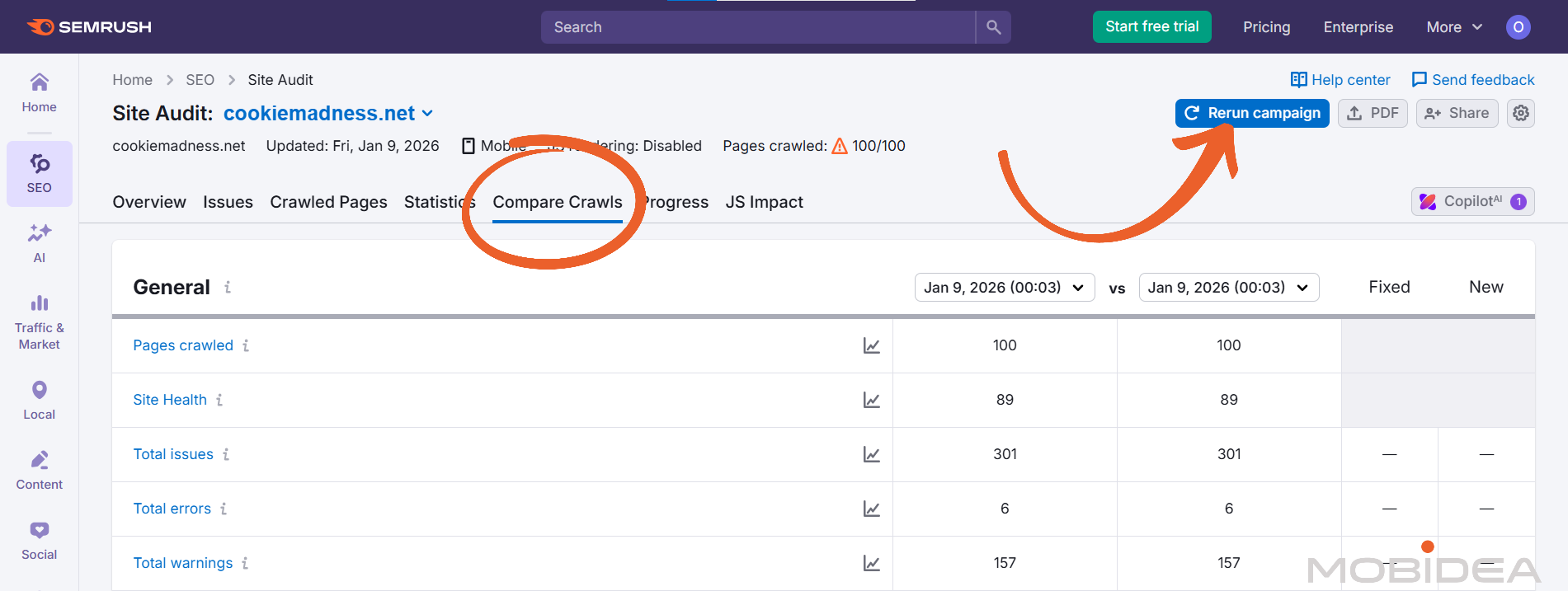
Run Web site Audit once more to examine progress:
- Has your Web site Well being Rating improved?
- Are indexing charges higher?
- How’s natural visitors trending?
Use Web site Audit’s “Evaluate Crawls” characteristic to see precisely how your metrics modified.
Understanding Your Choices: NoIndex, Delete, or Redirect
Use noindex when: You want the web page for customers however don’t need Google to index it.
Add a noindex tag (a chunk of code telling search engines like google to not embody this web page in search outcomes) to the web page’s code.
This works for duplicate content material that serves customers however shouldn’t compete for rankings.
Delete when: The web page has zero worth—no visitors, no backlinks, no conversions, a number of technical issues.
Simply take away it utterly.
Use 301 redirects when: The web page has visitors historical past or backlinks.
You ship that authority to a greater web page by establishing a redirect.
That is the way you consolidate hyperlink fairness (the rating energy handed by hyperlinks) whereas cleansing up your web site.
What to Count on After Pruning
Right here’s what sometimes occurs while you prune accurately:
Week 1-2: Momentary confusion.
Google could present some rating fluctuations because it processes your modifications.
That is regular.
Don’t panic and reverse your selections.
Week 3-4: Indexing improves.
Your remaining pages get crawled extra regularly.
Web site Audit will present sooner crawl occasions and higher protection of your vital pages.
Week 5-8: Rankings enhance.
As crawl price range concentrates on high quality content material and duplicate points resolve, your good pages begin rating larger.
You’ll see natural visitors improve despite the fact that you could have fewer pages.
Month 3+: Authority concentrates.
As a substitute of spreading skinny throughout hundreds of mediocre pages, your web site authority focuses on fewer, stronger pages.
These compound rating enhancements over time.
Monitor your restoration utilizing:
- Web site Well being Rating in Web site Audit (ought to enhance considerably)
- Indexing protection in Google Search Console
- Natural visitors traits in Google Analytics
- Rankings for precedence key phrases in Place Monitoring
Some websites see fast enhancements.
Others take 2-3 months for Google to totally course of the modifications.
Both means, the technical basis is stronger, setting you up for long-term progress.
Stopping Future Quantity Traps
You’ve mounted the mess.
Now that you must forestall it from occurring once more.
The identical Content material Toolkit instruments you used for enchancment work for prevention—you simply apply them at a unique stage of your workflow.
Validate Subjects Earlier than Task
The amount lure begins with matter choice.
Groups create content material with out checking demand first, then uncover months later (through Web site Audit) that no person searches for these subjects.
By then, you’ve already constructed poisonous mass.
Apply Matter Finder earlier than project:
Use the identical Matter Finder workflow detailed in our Enhancing Content material part above, however run it BEFORE you assign content material to writers, not after pages are already revealed and underperforming.
The method is similar—enter your broad matter, assessment website positioning knowledge (search quantity, issue, intent), examine associated questions.
The distinction? You’re stopping zero-demand content material from ever getting created as a substitute of pruning it later.
If a subject reveals zero search quantity or impossibly excessive competitors, reject it on the very starting.
Each piece you don’t create as a result of it fails validation is one much less web page that may want pruning in 6 months.
Matter Finder’s weekly rotation characteristic is especially precious for prevention—you get contemporary validated concepts robotically, so your group all the time has confirmed subjects to work from as a substitute of guessing.
Create Information-Pushed Briefs to Stop Skinny Content material
The second reason behind quantity traps?
Publishing with out clear high quality targets.
Writers produce 300-word posts as a result of no person specified that opponents have 1,500 phrases.
The content material goes reside, fails to rank, and turns into future pruning work.
Apply website positioning Transient Generator to new content material: Comply with the identical workflow described above for creating briefs with goal phrase counts, secondary key phrases, and full outlines.
Confirm High quality Earlier than Publishing
For prevention, you utilize the very same Content material Optimizer workflow mentioned above, however on drafts BEFORE they go reside.
The appliance distinction:
- For enchancment: Add revealed web page → see what’s damaged → repair it → republish
- For prevention: Add draft → validate it meets requirements → repair issues BEFORE publishing → publish clear
That is the important mindset shift: Content material Optimizer prevents technical debt reasonably than repairs it.
Issues get mounted earlier than they have an effect on your Web site Well being Rating or waste crawl price range.
Set Publication High quality Necessities
Earlier than any content material goes reside, require these minimums:
Technical necessities validated in Content material Optimizer:
- website positioning rating 80+ (proves key phrase protection and topical relevance)
- Readability rating 80+ (ensures accessibility for non-native audio system)
- Tone rating matches your model voice
- Goal phrase rely met (based mostly on website positioning Transient Generator suggestions)
Technical checks in Web site Audit:
- No damaged hyperlinks (take a look at URLs earlier than publishing)
- Masses shortly
- Correct heading construction
Content material necessities:
- Matter validated in Matter Finder (confirmed search demand)
- Demonstrates real experience, not simply key phrase protection
- Doesn’t duplicate present pages (Content material Optimizer’s originality examine confirms this)
If a draft doesn’t meet these requirements, it goes again to the author for revision utilizing Content material Optimizer.
By no means publish content material that will instantly present up as an issue in your subsequent Web site Audit.
Monitor with Web site Audit to Catch Points Early
Schedule Web site Audit to run weekly.
Even with prevention techniques, monitor for:
- Web site Well being Rating drops (signifies new issues slipping by)
- New technical points showing in bulk
- Damaged hyperlinks or crawl depth will increase
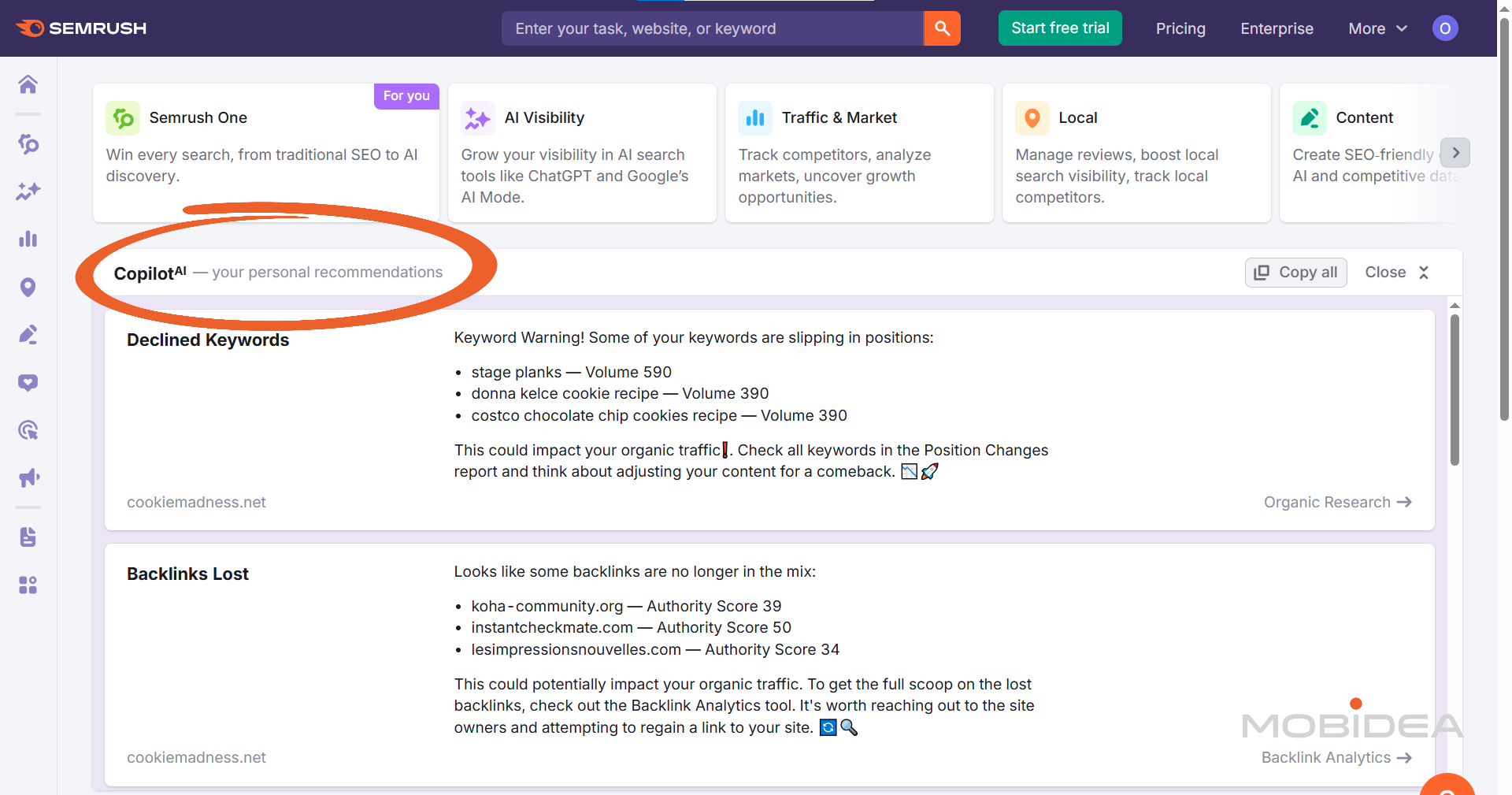
Use Semrush Copilot for alerts about technical issues earlier than they pile up.
When Web site Audit flags new points, examine instantly.
One warning about duplicate content material caught early is far simpler to repair than fifty pages needing pruning later.
You will discover Copilot suggestions in the primary dashboard.
The Outcome: Sustainable High quality at Scale
You now know tips on how to repair the amount lure: diagnose with Web site Audit, enhance effectively with Content material Toolkit, prune what doesn’t work, and forestall future issues.
The instruments can be found.
What issues now could be taking motion.
You may keep a publishing rhythm that doesn’t create result in the amount lure as a result of:
- Each matter validates earlier than project (Matter Finder)
- Each transient units clear high quality requirements (website positioning Transient Generator)
- Each draft will get validated earlier than publishing (Content material Optimizer)
- Technical issues get caught instantly (Web site Audit weekly monitoring)
Keep in mind that the longer you wait, the extra pages pile up and the tougher the cleanup turns into.
So join a 7-day free trial for Semrush One and repair this drawback right now.
Commercial


![Mobidea Advertiser Onboarding Guide [2026 Update]](https://18to10k.com/wp-content/uploads/2026/02/mobidea-advertiser-onboarding-guide-350x250.png)
![Mobidea Facts & Figures [Updated 2026 ]](https://18to10k.com/wp-content/uploads/2026/01/Mobidea-Facts-and-Figures-350x250.png)
![Mobidea Affiliate Onboarding Guide [2026 Update]](https://18to10k.com/wp-content/uploads/2026/01/mobidea-affiliate-onboarding-350x250.png)